
How Strong Is Your
Self-Control?
This brief quiz measures your level of self-control — your ability to resist temptation, break bad habits, stay focused, and make decisions that align with your long-term goals.
By reflecting honestly on 13 statements, you'll gain a snapshot of how well you regulate your impulses and behavior in everyday life. Use your results not as a final verdict, but as a starting point for understanding where your willpower thrives — and where it could use a little more attention.
How to respond: For each statement, choose how much it applies to you on a scale of 1 to 5.
There are no right or wrong answers. Answer as honestly as possible — scoring is handled automatically.
Quiz Complete
Your Answer Breakdown
What Was Your Score?
No matter what your score was, remember it’s a neutral piece of data, it’s not a verdict on who you are. The average person scores around 32, and most people fall somewhere in the moderate range. Everyone struggles with self-control from time to time; it’s simply part of being human. What matters far more than where you land today is what you choose to do with the awareness this score gives you. Self-control isn’t a fixed trait you’re born with or without — it’s a skill, and like any skill, it grows with intention and practice. Whether your score surprised you, confirmed what you already knew, or somewhere in between, you now have a clearer picture of where you stand. That awareness opens opportunity for growth.
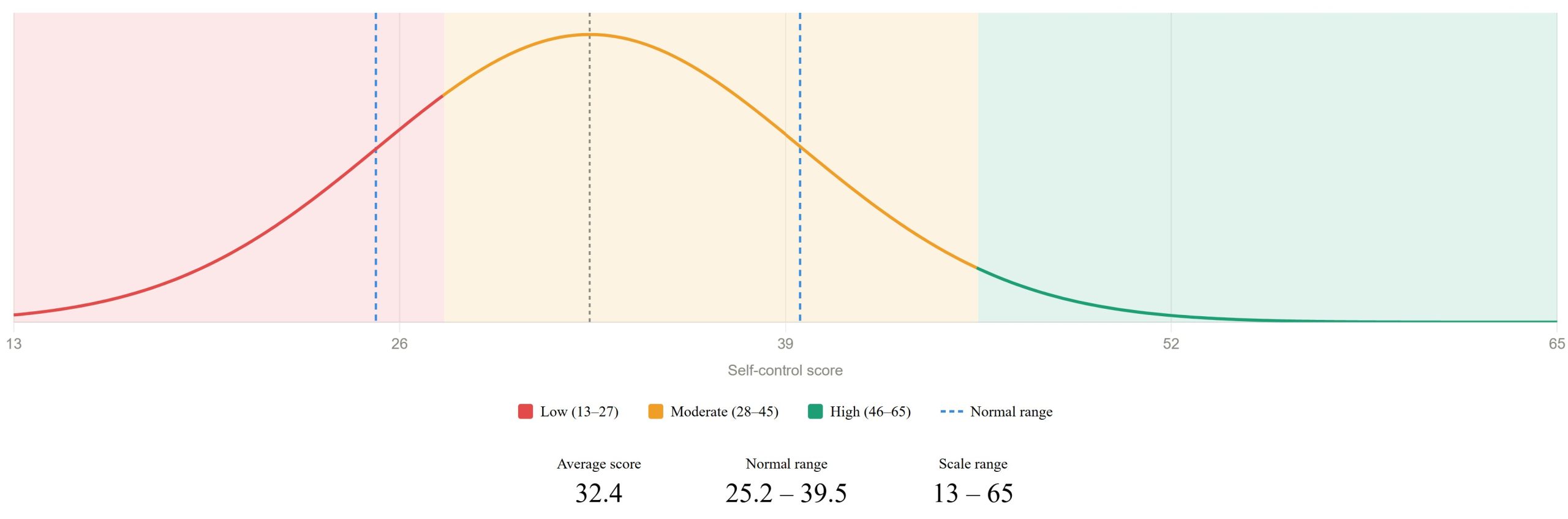
So what do you do with this neutral information? Well let’s a look at what self-control is, how to grow it, how to recharge it, and why this matters at all.
What Is Self-Control?
Self-control is the ability to regulate your thoughts, emotions, and behaviors in the moment — choosing what serves your long-term wellbeing over what feels easiest or most satisfying right now.
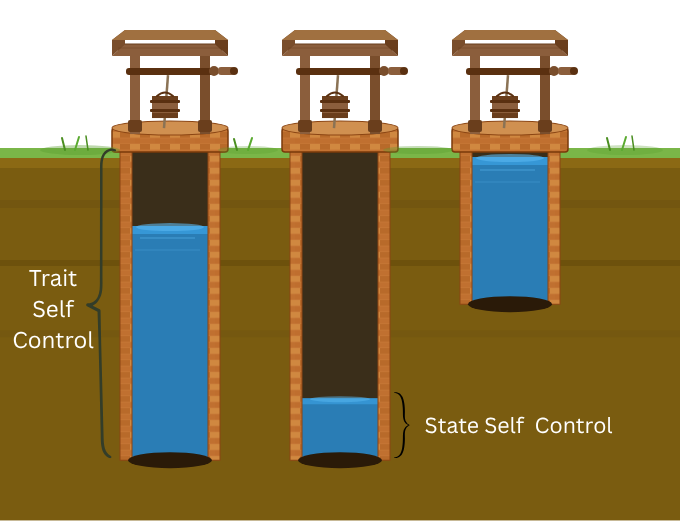
Trait self-control is your stable, long-term capacity for self-regulation — the baseline level of discipline that tends to follow you across situations, relationships, and years. It reflects who you generally are, not what’s happening in your life right now.
State self-control is your self-regulatory capacity at a given moment in time — heavily influenced by current stress, sleep, emotional load, life circumstances, and even how depleted or energized you’re feeling that week. It fluctuates.
Now if that sounds a bit technical, that’s ok. Let’s break it down with an analogy. Self-control is a depletable resource, like a well that can be drawn upon. The more self-control you use, the less you have to continue to use at that time. It needs to be recharged so you can can use more in the future. Another way to think of is is like a body builder; they build up their muscle ability, but after using that ability at an intense gym session, they need to rest to regain their strength. Here’s a visual of the wells to further clarify:
What Drains Self-Control?
Given self-control is a depletable resource, what kind of activities drain it?
Decision making – Every time you make a decision, a little bit of your self-control is used up. Thus, when you have to make a lot of decisions in a short time frame, multitask, or when you overthink things, your self-control is being drained. That’s why people will often (and naturally) have less self-control in the evenings after work or near the end of their work week.
Emotional regulation – Stuffing down anger, sadness, fear, frustration etc. has quite a few negative affects, but one of them is drawing on your well of self-control. It takes a lot of energy to deny what your psyche/body is trying to process.
Your Body – Lack of sleep and lack of proper nutrition have a negative affect on self-control. You are more likely to make bad decisions when you’re sleep deprived or have been eating unhealthy.
Your Behaviors –
- Resisting temptation uses up self-control. Whatever you’re resisting is probably good for you to do so, but it still uses your self-control to continue that resistance. Try to avoid putting yourself in situations where you know you’ll face temptation.
- Not Holding Boundaries leaves us feeling less-than. This feeling gives less willpower to maintain self-control.
- Instant gratification lowers self-control through a use-it-or-lose-it process. Continuously allowing instant gratification leads one to have less ability to handle stress, boredom, or avoid quick-fixes.
How Do I Manage Self-Control?
Stop the Drain
First step in managing self-control is to take steps to stop the drain. There are small things you can do here and there, though keep in mind using self-control in unavoidable.
- Build consistent night & morning routines. Staying with a consistent pattern of behaviors and sleep schedule helps it become autopilot, this using less self-control.
- Focus on one thing at a time. Given decision making depletes self-control, try to work on one task, then another so you’re not making as many decision with split focus at a time.
- Be aware of your environment. If you know you have a hard time resisting a particular thing, try to not have that thing in your environment (classic example, don’t have the candy/soda/ice cream in your living space).
Build Your Trait Self-Control
Self-control is built up the same way a body builder increases their muscles; by pushing it’s limits. You can give yourself tasks that you know will take a lot of your attention, then push the timeframe of those tasks further and further past the point you would normally stop being attentive, even if just 5 minutes at a time. You can take on mentally hard tasks when you are tired. You can push yourself physically to increase self-control via the mind-body connection. Examples of that would be to do one more rep in each workout, hold your speed just a little longer when jogging, or of less intensity, sit upright or hold a plank longer than comfortable, pushing your limits just a little bit more each time. Just remember to allot yourself time for recharging when planning these methods.
You can also deepen your own self-control by living within your values and boosting your self-esteem. Ever heard the phrase “a rising tide floats all boats”? It applies to our minds/bodies too. When a person grows their pride in themselves, lives within their values, maintains their boundaries, celebrates their wins…. all of this leads to a better mental/emotional state that will deepen your well of self-control in the long run.
Recharge Your State Self-Control
While using self-control can be managed, its use can’t be negated completely. Of course your going to be making decisions, paying attention to life, feeling the feels, etc. So it’s important to know what works for you to recharge. Ideally, activities to recharge self-control are of low to no mental intensity. One example is watching TV reruns. Watching shows/movies in an of themselves isn’t recharging; if it’s something you haven’t seen before, like the new episode that just came out or a new movie you haven’t seen, your mind still has to pay attention to take in the new information. However, watching your favorite shows you’ve already seen before isn’t as mentally taxing and allows your mind to relax. Coloring in adult coloring books is akin to flow state. Lounging by a pool, getting a massage,
Meditation frequently comes to mind when thinking about relaxing activities, but there’s a caveat with that. Mediation can be recharging for a person practiced in meditation. If you’re not used to meditating, it can take a lot of mental effort while learning the process. Here’s an exercise for you: close your eyes and think of the number 1. Keep repeating it in your head until a stray thought comes up, then go to number 2. When the next stray thought comes through your mind, go to number 3. Each time a stray thought other than the number comes in your head, go up a number. Try this while setting a timer for 1 minute. How high did you get? Did you even notice the stray thoughts in the first few seconds or had it and went back to counting the same number? If you make a daily habit of this exercise, your skill will increase, which will demonstrate the difference in mental attention between being skilled and not skilled in meditation.
If you want to take this to the next level, here are some journal prompts that you can reflect on and write about to take your learning to a deeper level:
- What was your score in the BSCS?
- What are your interpretations of the results? Does it fit your impression of yourself?
- What are some examples of times your self-control didn’t hold up? It might be something big like not holding a boundary with someone when you knew you should, or small like having that dessert you knew you shouldn’t.
- What are some practices you can put into your life to stop the drain?
- What are some activities that use your self-control, that you can push further for the purpose of increasing your well?
- What are some activities that you enjoy for recharging your self-control?
Your Next Steps
IntegriCoach offers multiple pathways to help you take your life to the next level! Whether you want to boost your self-control, your self-esteem, your self-awareness, or if you’re ready to put the pedal to the metal and produce tangible results in your life, we can help!
Our main offerings:
- The Samurai Game® is an intense, two-day experience where you take on the mindset of a medieval Samurai and learn what it means to live your life as a warrior. Tap into your honor, courage, perseverance, and balance as you participate in a great battle filled with drama and death! The interactive, on-your-feet nature of this experience helps the awareness stick.
- Insight and Impact (self guided) – These are our self-guided online courses designed to increase your self-awareness, self-esteem, and help you create and action plan for you life alongside tools to help you stick to it! Work at your own pace.
- Insight and Impact (One-on-one walk through) – Our powerful curriculum divided over 12 weeks with personal one hour video calls each week. This gives you time to discuss the information with your coach, giving you personalized insight and individual application of the material.
- Accountability Buddy – this is a supplement after completion of the Insight and Impact experience. Once you’ve got your action plan together, having a coach as an accountability buddy through 30 minute calls each week makes sure you stick to your plan and stay in your vision of why you’re creating life with intention!
For more information on any of these, visit www.integricoach.com or email us at [email protected]